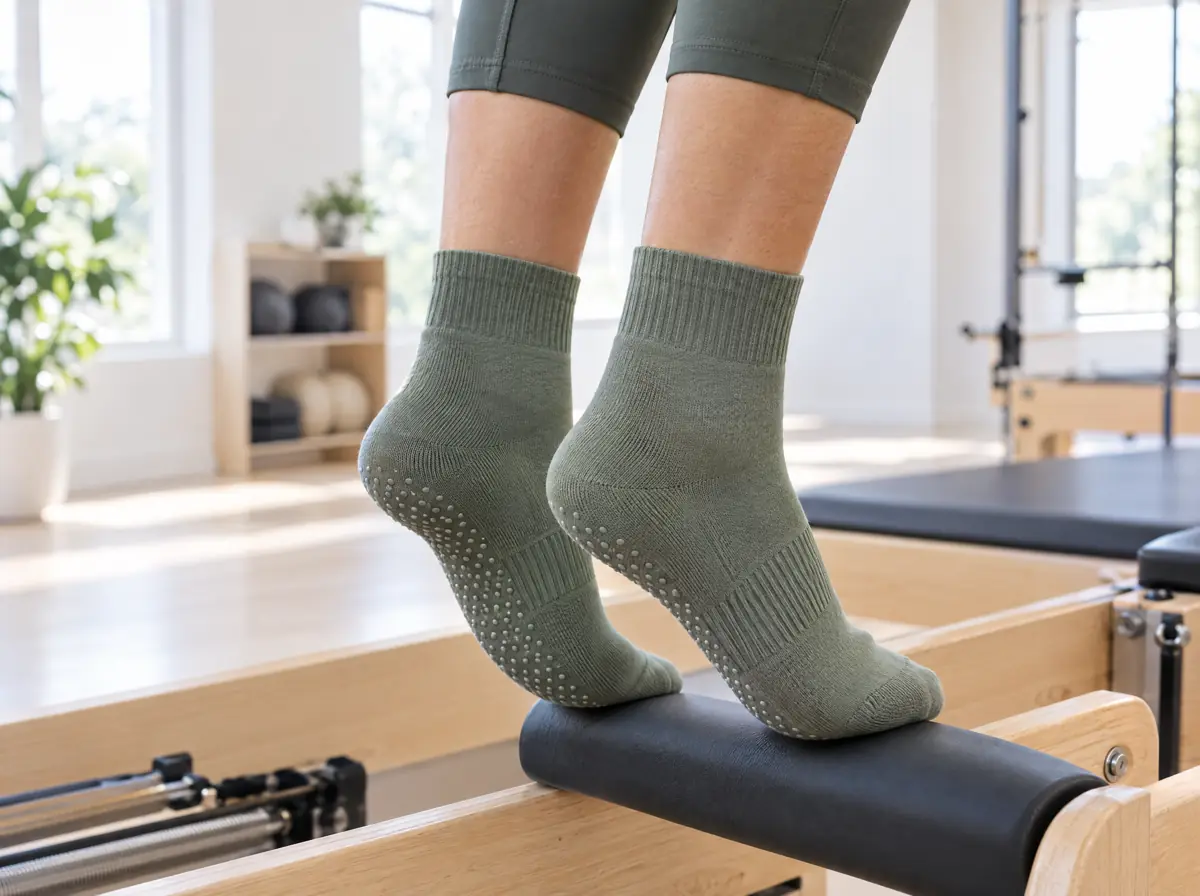
Studio grip sock policies in Toronto and across Canada.
If you've booked your first reformer or barre class in Toronto, Vancouver, Calgary, Ottawa or Montréal, your confirmation email may mention grip socks. Here's how these policies usually work.
Why studios ask for grip socks
Studios set their own rules. Common reasons they give include keeping shared equipment and floors clean, consistent footing on reformers and floors, and general studio etiquette. Your studio's own wording is the one that counts.
How to check your studio's policy
- Look at the FAQ or "first class" page on the studio's website.
- Read your booking confirmation from the studio's booking app.
- Ask the front desk; they can also tell you if they sell socks or rent them.
Common variations
- Required for reformer, optional for mat. Some studios only ask for grip socks on equipment.
- Any grip sock vs a specific style. Many accept any grip sock; a few have a preference for toe style. Ask if you're unsure.
- Socks sold at the desk. Handy if you forget.
Bilingual studios and Quebec
In Quebec, studio communications are in French, often alongside English. You'll see grip socks called bas antidérapants or chaussettes antidérapantes. Lumen Barre packaging is planned with English and French on every label. Lire ce guide en français.
For studio owners
If you sell grip socks at your front desk and are interested in a planned closed-toe option with planned bilingual labels, we're talking to a small group of founding studios. Email us for planned wholesale details.
This guide is general information, not studio policy or advice. Always follow your studio's rules.